
Dr Guleria was appointed as the director for a term of five years on March 28, 2017.

The renowned pulmonologist, who was part of the national COVID task force, highlighted the need for research on developing vaccines which will cover not only the current circulating strains but also from the emerging variants.

If people are careful and India is able to vaccinate a large number of population, then the third wave of COVID-19 pandemic may not even come, said All India Institute of Medical Sciences Director Dr Randeep Guleria on Thursday.

As India witnessed the highest number of Covid cases in over four months, former All India Institute of Medical Sciences (AIIMS) director Dr Randeep Guleria on Wednesday said the new XBB.1.16 variant could be driving the recent rise but emphasised there was no need for panic as long it does not cause severe illness and deaths.
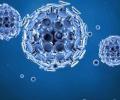
The presence of spike protein facilitates a virus' entry into the host cell and is responsible for making it transmissible and causing infection.
'We should hope that things are not as bad as in the United Kingdom'

India Today ranks the best colleges in the country.

The 93-year-old leader was admitted to the hospital on June 11.
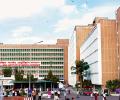
The tenure of the incumbent AIIMS director, Dr Randeep Guleria, which was set to end on March 24, was extended by three months.
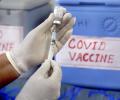
The COVID-19 vaccines can be "tweaked" to provide protection against new variants of the virus, All India Institute of Medical Sciences (AIIMS), Delhi, Director Dr Randeep Guleria said.

According to the AIIMS director, there are 10-15 per cent of people who may witness severe infection and may need extra medicines like Remdesivir, oxygen or plasma. Less than five per cent of patients need to be operated on a ventilator, he informed.

As of Friday, Gujarat's COVID-19 count stood at 7,403 cases, of which 5,260 were from Ahmedabad district alone, while of the 449 deaths in the state, 343 were from the city.

AIIMS-Delhi is among the 12 sites selected by the Indian Council for Medical Research (ICMR) for conducting Phase I and II randomised, double-blind and placebo-controlled clinical trials of Covaxin.

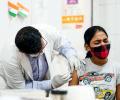
The first COVID-19 vaccine shots in India were given on Saturday to nearly two lakh frontline healthcare and sanitary workers as Prime Minister Narendra Modi rolled out the world's largest inoculation drive against the pandemic that has caused 1,52,093 deaths and upended millions of lives in the country.
"One CT scan is equivalent to 300 to 400 chest x-rays. According to data, repeated CT scans in younger age groups increase the risk of cancer in later life. Exposing yourself to radiation again and again may cause damage. So, there is no point in doing CT scan in mild COVID-19 if the oxygen saturation is normal," Guleria said.
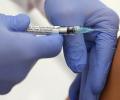
In phase I, the vaccine would be tested on 375 volunteers and the maximum of 100 of them would be from AIIMS.
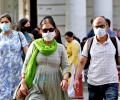
According to some experts, there is not much difference in the number of seasonal flu cases and that of COVID-19, even though they stressed that surveillance for newer variants should continue in the off chance of a new lineage of coronavirus catching the country off guard.

The finance minister, suffering from a kidney ailment, has been undergoing dialysis for the last one month.
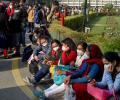
On Monday, around 5,000 nurses of the All India Institute of Medical Sciences in New Delhi went on a strike over their long pending demands, including those with regard to the Sixth Central Pay Commission.

The finance minister has been suffering from a kidney ailment and skipped office since Monday.
The trial is being conducted in three phases by segregating children into categories according to their age. The first trial was started in the age group of 12 to 18 years followed by the age group of 6 to 12. Trials for children between the ages of and 2-6 years are currently undergoing trials.

A kidney transplant operation was scheduled for Saturday and all formalities for a donor kidney were also completed.
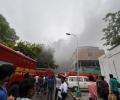
The AIIMS administration has initiated an internal inquiry to look into the cause of the fire and further strengthen preventive measure.
These kinds of assumptions to be used for a nation of India's size and "to put us in poor light is not desirable"
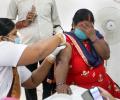
Not enough data has been generated locally to decide on the need for a booster dose of COVID-19 vaccine for those fully inoculated, say experts amid the possibility of a third wave of the viral disease hitting the country between September and October.

They stressed that classification of cases into mild, moderate and severe categories based just on respiratory symptoms should be relooked to include other organ involvement.
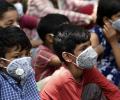
Zydus Cadila COVID-19 vaccine for children above 12 years is expected to be available by August as its trials are likely to be completed by July-end, said Dr N K Arora, Chairman, National Technical Advisory Group on Immunisation (NTAGI).

'There is no data to show this virus is more deadlier.'

In a video issued by the Health Ministry, Dr Randeep Guleria, Director of the All India Institute of Medical Sciences (AIIMS) answered commonly asked questions regarding the dosage of the vaccine saying that two doses of the vaccine will have to be taken 28 days apart and protective levels of antibodies generally would develop two weeks after the second dose.

One 'severe' and 51 'minor' cases of AEFI (adverse events following immunisation) were reported among healthcare workers who were administered the coronavirus vaccine in Delhi on the first day of the COVID-19 vaccination drive on Saturday, official figures showed.

"Lives of another 60 'sickest' patients at risk. Major crisis likely," he said.

Delhi recorded 954 cases on Monday, according to a health department bulletin. The bulletin said the number of tests conducted too was the lowest in July.

The highest number of confirmed cases are from Maharashtra (748), followed by Tamil Nadu at 571 and Delhi with 523 cases. Cases in Telangana have gone up to 321, in Kerala to 314, in Uttar Pradesh to 305, while the number of cases has gone up to 274 in Rajasthan.
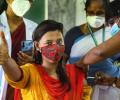
The government said it had been evaluating the implementation of the decentralised model of vaccination since its launch on May 1 and that the decision to centralise it again was taken after detailed deliberations and following requests by some states, amid claims by the Opposition that the policy change was due to the Supreme Court's intervention.

'Since the Covid virus has a tendency to mutate, we can continue to expect new variants of the virus to emerge and keep circulating and recirculating in the communities.'

With the Omicron variant of coronavirus slowly spreading its tentacles in the country, a number of states enhanced surveillance to trace, track and quarantine contacts of COVID-19 positive persons while Delhi began genome sequencing of samples of all infected people and has prohibited Christmas and New Year gatherings.
Whether the third wave will ravage us depends on the pace of vaccinations, careful and calibrated opening up of establishments, and a strategy to contain the spread in specific states or pockets.
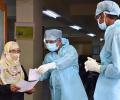
'The fight against COVID-19 is not a hospital fight.' 'It's a community level fight. 'If your community level measures are good, you can decrease the number of people coming to hospitals, or flatten it.'
The prime minister also visited the Ram Manohar Lohia Hospital in New Delhi after the milestone was achieved and interacted with hospital officials.

Addressing a press briefing, health ministry Joint Secretary Lav Agarwal said currently there are no approved therapies for COVID-19 and there is not enough evidence to claim that plasma therapy can be used for treatment of the disease.
